
What Happens Inside a Die.
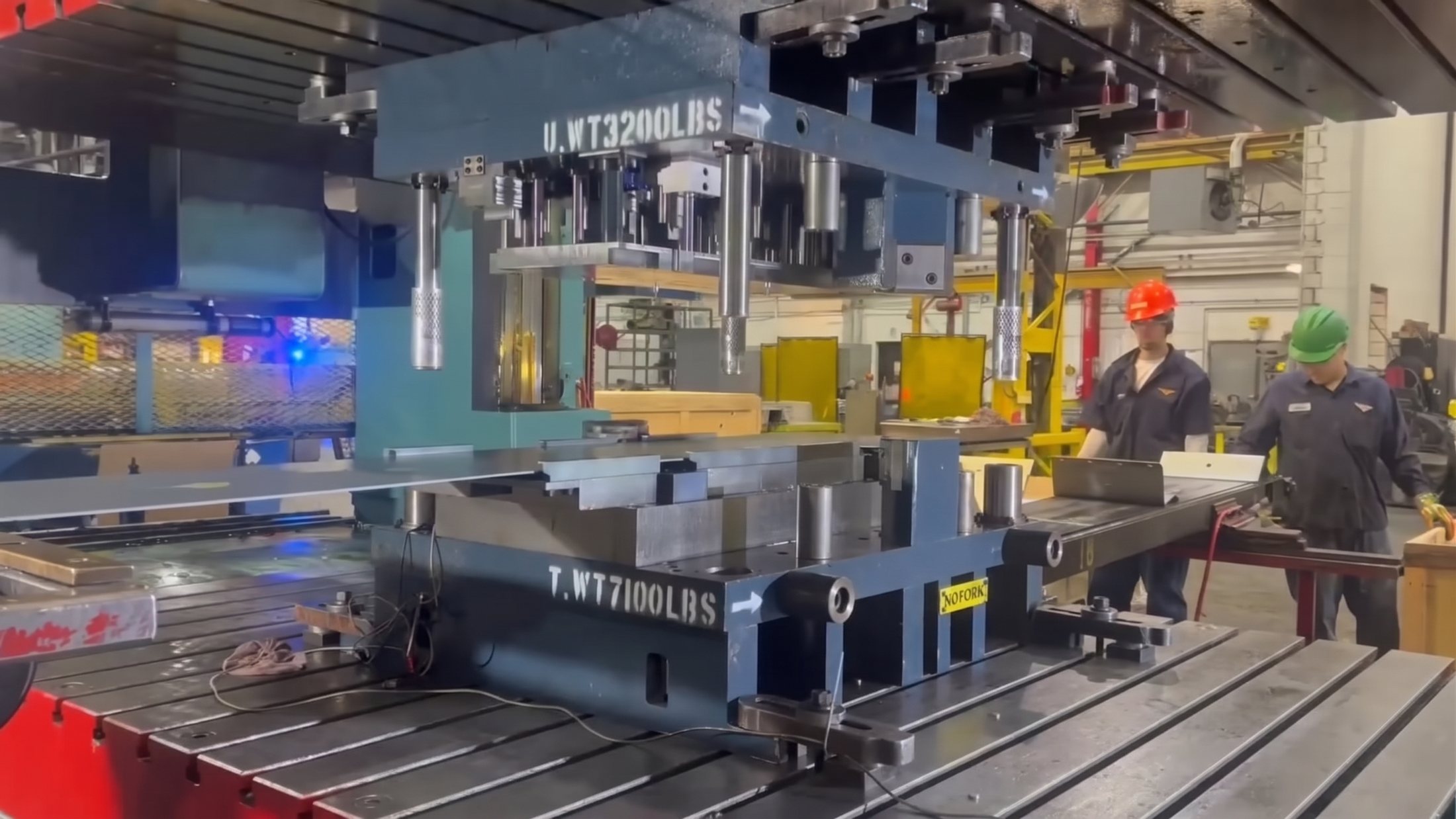
Every blank is cut by a die: two hardened steel halves that close on the strip like a cookie cutter. Here is one stroke, slowed down.
This animation needs WebGL, which this browser has turned off. The steps explain what it shows.
Pick a step to jump the animation to it.
The press ram drives the upper die down onto the strip. Its punch is the exact shape of the blank.
The punch pushes past the edge of the lower die and shears the steel, the way a paper punch cuts a hole. The blank drops out underneath.
The ram lifts and the feeder pulls the strip forward 24 inches, so fresh steel is under the punch for the next stroke.
Same Stroke, Different Jobs.
The animation shows a blank-through die, the simplest kind. Our die shop also runs compound and progressive dies when a part needs holes or more than one operation.
-
Blank-Through
The punch pushes the blank down through the die and it drops out underneath. Fast and simple, and the workhorse for circles.
-
Compound
Blanks the outside and pierces the holes in the same stroke, so every feature lines up with the edge exactly.
-
Progressive
The strip moves station by station, with an operation at each one, and a more complex part comes off every hit.
Why the Die Matters
A die is built for one part. It costs money up front, but once it is made every blank comes out the same, stroke after stroke.
Which kind of die depends on the part: a plain shape, a shape with holes that must line up, or a part that needs several operations.
See Our Blanking CapabilitiesWords to Know
- Die
- The tooling, made of an upper and a lower half, that cuts or forms steel in a press.
- Blank-through die
- A die where the punch pushes the blank down through the die opening, so the part drops out below.
- Compound die
- A die that blanks the outside and pierces the holes in the same stroke, so features line up exactly.
- Progressive die
- A die with several stations; the strip moves through them and a finished part comes off each stroke.
- Burr
- The small raised edge left where steel was sheared. Kept within a set height on the print.
Die Questions.
Which kind of die costs more?
Usually progressive, then compound, then blank-through. More stations and more features mean more die to build.
What is die clearance?
The gap between the punch and the die. It is set to the thickness and grade of the steel, and it decides how clean the cut edge is and how much burr is left.
How long does a die last?
It depends on the steel and the volume. Dies are sharpened and maintained between runs, so a well-kept die runs for years.
Can a customer own the die?
Yes. The customer can buy the die and own it, or we own it as our tooling; the quote says which.