
How a Blank Becomes a Drawn Part.
Drawing pulls a flat blank into a die to make a cup, dish or tank head. The steel does not tear; it flows.
This animation needs WebGL, which this browser has turned off. The steps explain what it shows.
Pick a step to jump the animation to it.
A circle blank slides onto the lower die, centered over the opening.
The punch pushes the middle of the blank into the die. The steel does not stretch much; it flows in from the edge, so the outside shrinks as the walls form. A pad around the edge keeps the flange flat while it draws, so it does not wrinkle.
The punch lifts out and the part keeps its new shape.
The drawn part is lifted out and moves on to be trimmed, pierced or packed.
How Big a Blank Does a Cup Need?
Steel keeps about the same surface area when it is drawn, so the flat blank has to hold the area of the bottom plus the walls. For a straight-walled cup: D = √(d² + 4dh).
A cup 10 inches across and 4 inches deep needs a blank about 16.1 inches across. That is a draw ratio of 1.61, under the 1.8 to 2 that steel usually draws in one stroke.
Try the Cup Blank CalculatorWords to Know
- Drawing
- Pulling a flat blank into a die to make a cup, dish or shell.
- Draw ratio
- Blank diameter divided by cup diameter. Steel usually draws about 1.8 to 2 times in one stroke.
- Blank
- A flat piece of steel cut to shape from coil or sheet, ready for the next operation.
- Stamping
- Forming steel into a three-dimensional shape in a press: drawing, bending, piercing, embossing.
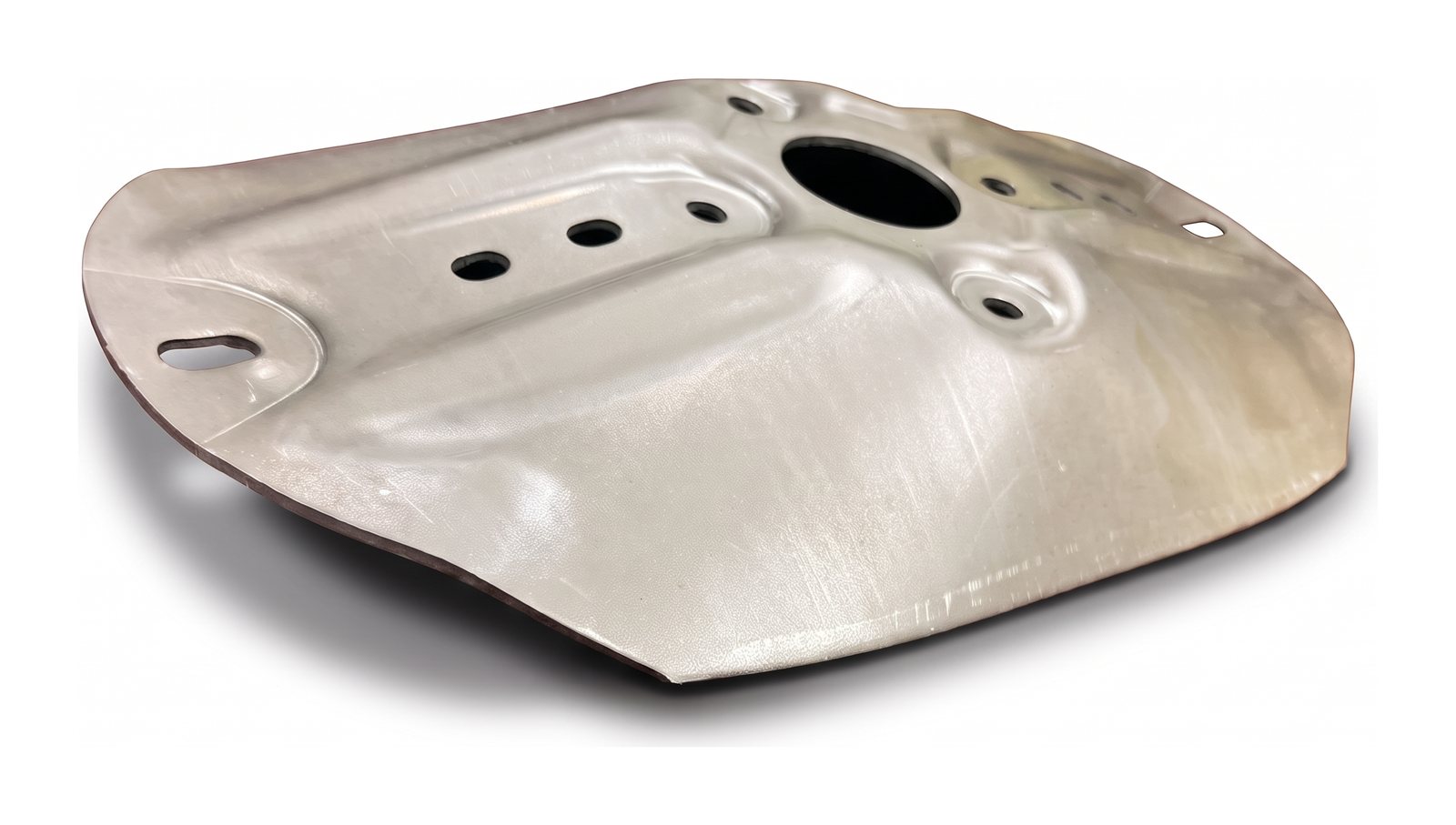
Drawing Questions.
Why does a drawn part wrinkle?
The flange buckles when too little pressure holds it flat as it flows into the die.
Why does a drawn part tear?
The draw is too deep for the steel in one stroke, or a corner radius is too tight.
What is a redraw?
A second draw that makes a cup narrower and deeper than one stroke can.
How big a blank does my cup need?
Use the Cup Blank Size Calculator; it also plans the draws stroke by stroke.